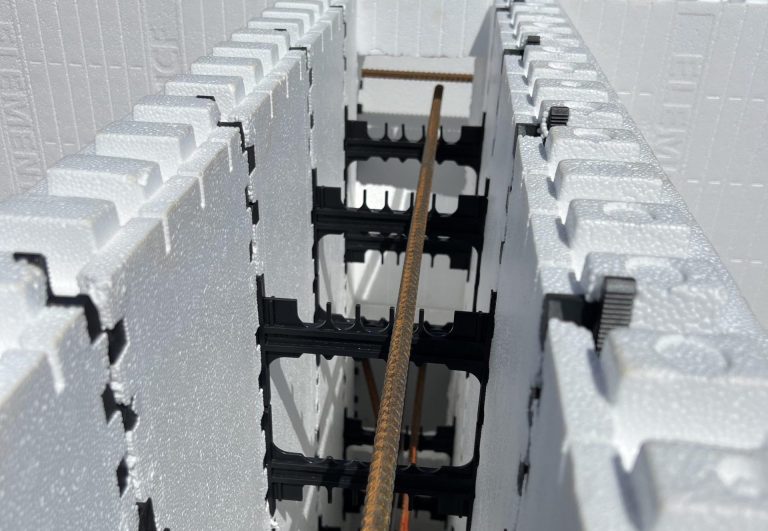
At A Glance
EPS ICF wall assemblies, including Element ICF, have validated NFPA 285 compliance.
Results expand ICF use into mid- and high-rise projects under Types I–IV construction.
Testing covered both brick veneer and ACM cladding assemblies.
Element ICF matches the tested system, giving designers confidence in code compliance.
In a significant step forward for the ICF industry, the Insulating Concrete Forms Manufacturers Association (ICFMA), in collaboration with the National Ready Mixed Concrete Association (NRMCA), has successfully completed NFPA 285 testing for wall assemblies incorporating EPS ICF systems. This initiative directly supports broader commercial applications for ICFs, particularly in multi-storey and larger structures subject to stricter fire safety code requirements in the United States.
Background: The Need for NFPA 285 Testing
U.S. building codes—specifically Section 2603.5.5 of the International Building Code (IBC)—mandate compliance with NFPA 285 when combustible materials such as foam plastic insulation are used in exterior wall assemblies for Types I through IV construction. As the ICF industry continues to grow beyond low-rise residential applications, fire safety compliance has become a critical component in advancing adoption.
To help address this, ICFMA initiated a structured testing program to validate the performance of EPS ICF assemblies when subjected to NFPA 285 fire propagation evaluations. This testing was designed not only to comply with existing regulatory frameworks but also to enable ICF solutions for higher-density construction projects.
The ICFMA’s Role and Testing Process
The ICFMA is a not-for-profit industry association representing the majority of North American ICF manufacturers. Logix Brands, the manufacturer of Element ICF, is an active member of the ICFMA, and Element ICF falls within the technical characteristics of the ICF used in the NFPA 285 tests—specifically, the original Logix ICF product.
Testing was carried out by Intertek in York, Pennsylvania, under the oversight of engineering firm Jensen Hughes. Their role was to design the test protocol, oversee testing execution, and issue technical justification for expanded use cases based on the results.
Tested Assemblies: Brick and ACM Veneers
Two different exterior wall assemblies were evaluated:
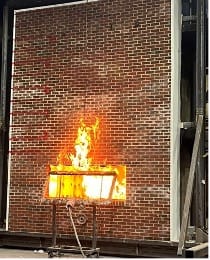
1. Brick Veneer Assembly:
- Interior gypsum wallboard
- 2¾-inch EPS foam ICF with 4-inch concrete core
- Water-resistive barrier and clay brick cladding
- 5″ fire-retardant wood buck and 2″ air gap
2. ACM Veneer Assembly:
- Similar ICF core configuration
- Type X exterior gypsum sheathing
- CommercialWrap WRB and 4mm fire-rated ACM cladding
- 3″ air cavity between cladding and sheathing
These assemblies were designed to represent both non-combustible and combustible cladding systems commonly used in mid-rise construction.
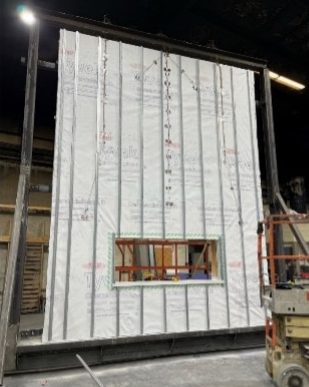
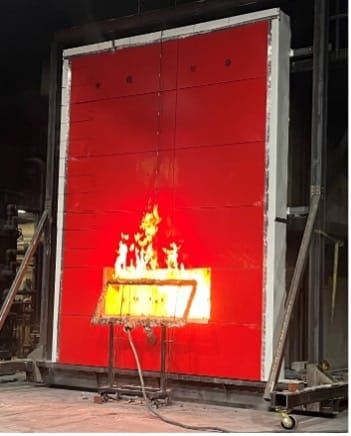
Wall Test 2 ACM Cladding
Conclusion: Proven Compliance and Broader Design Flexibility
Both wall systems passed NFPA 285 testing requirements, validating their use in code-compliant wall assemblies. More importantly, the findings allow for engineering judgment to be applied to alternate claddings, WRBs, and additional design conditions while maintaining compliance. The final report outlines thermally thick and thin veneer systems and specifies combinations of WRBs and claddings suitable for a range of project needs.
Don't miss a thing
Sign up to receive the latest info on new Element ICF products, special offers and more.
What This Means for Element ICF
Because Element ICF shares the same dimensional and material characteristics as the tested Logix ICF, and because Logix Brands is a full member of the ICFMA, the test results and associated engineering judgments apply directly to Element ICF. Designers, builders, and specifiers can confidently reference these results when considering Element ICF for Type I–IV projects requiring NFPA 285 compliance.
For technical teams seeking supporting documentation, Jensen Hughes’ engineering justification report and Intertek’s certified test data provide comprehensive design guidance.