Passive House Meets ICF — Part 3: Above-Grade Walls and Floor Connections
Print
Email
At A Glance
How the ICF concrete core contributes to the air control layer
What serves as the weather-resistive barrier in the wall assembly
Managing mechanical and electrical penetrations in an airtight wall
How floor systems connect to ICF while maintaining performance
Cladding attachment and the role of rainscreen assemblies
In Passive House construction, airtightness is one of the most critical performance targets.
Every joint, connection, and penetration must be carefully considered to prevent unwanted air leakage. While Insulated Concrete Forms are often recognized for their structural strength and insulation value, they can also play an important role in achieving a highly airtight building enclosure.
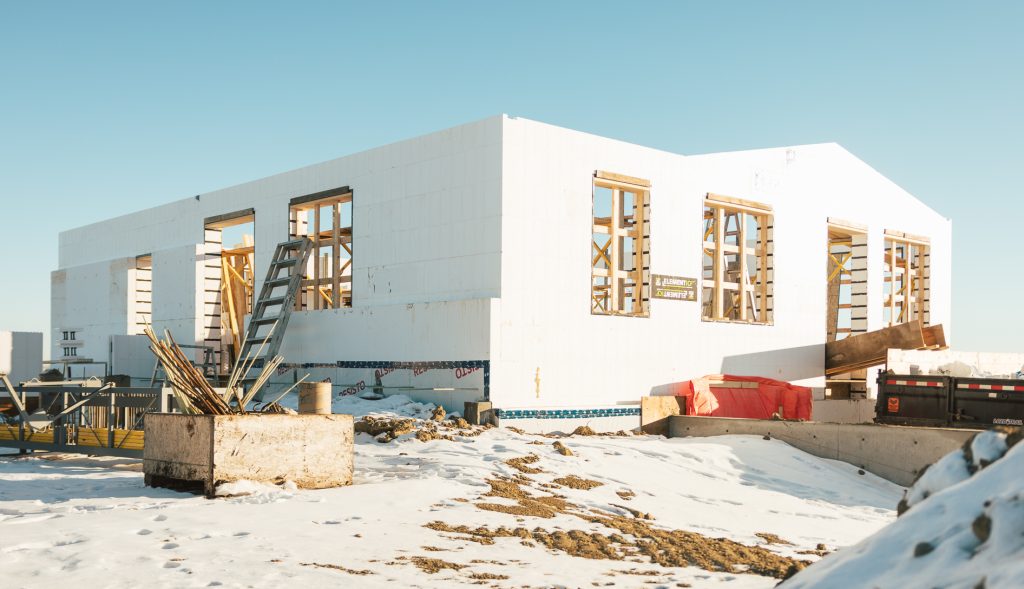
In this installment of the series, Dennis Borren explains how airtightness and wall detailing were approached in his Passive House project built with Element ICF.
You can continue reading below, or watch the interview segment to hear Dennis walk through these details in his own words.
Is the concrete core of the ICF wall used as the air control layer?
Yes. In this project the concrete core of the ICF wall is detailed as the air control layer.
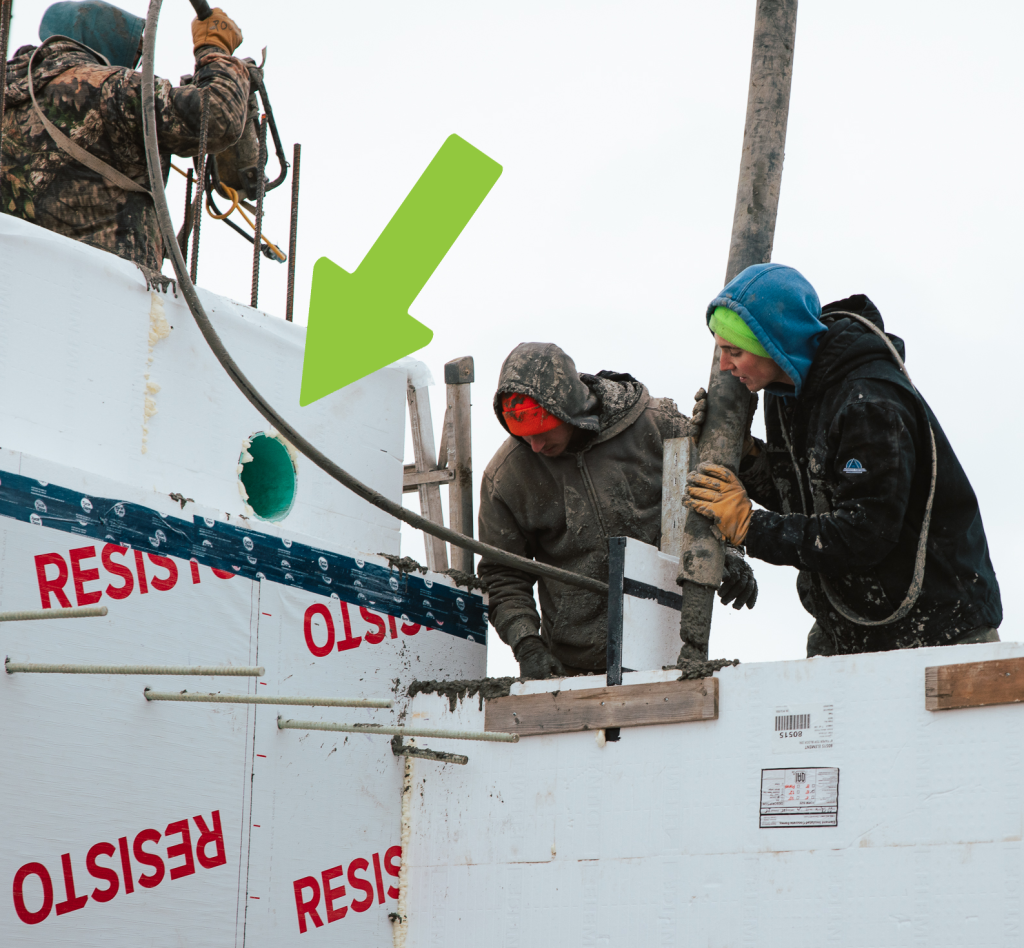
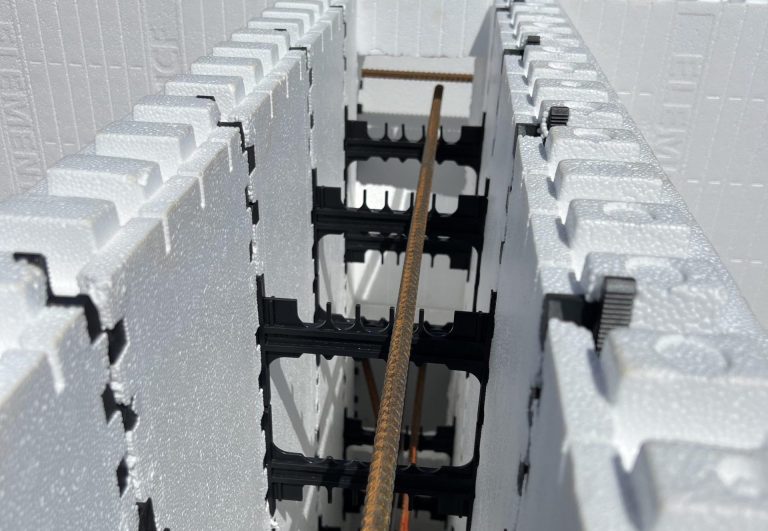
Maintaining that air barrier starts during the concrete pour. The concrete must be properly consolidated, which means vibrating the concrete as it is placed to eliminate honeycombing or air pockets. Any voids in the concrete could create gaps in the air barrier.
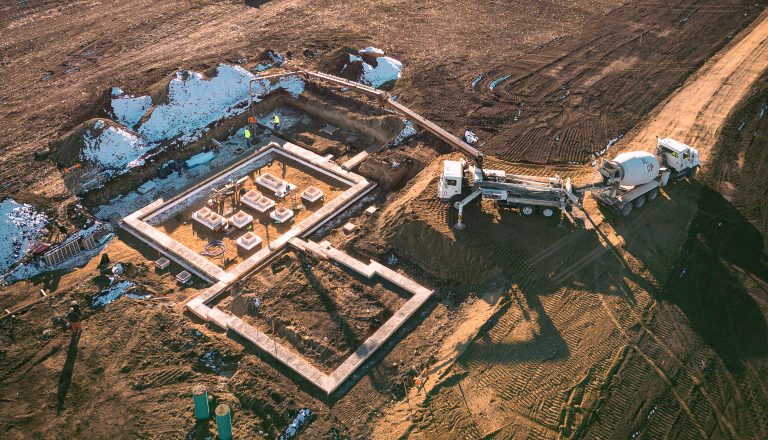
Another important detail is managing cold joints. If a pour has to stop, the surface needs to remain clean before the next lift is poured. During winter construction this means ensuring snow or ice does not enter the forms. If snow or ice were left inside the forms, it could melt later and leave gaps in the concrete.
The same applies when backfilling or working between lifts — dirt or debris cannot be allowed into the forms. The goal is always concrete poured against concrete, maintaining a continuous air barrier through the wall system.
When the ICF concrete core remains continuous and properly connected to adjacent assemblies, it can serve as the primary air control layer in a high-performance wall system.
What serves as the weather-resistive barrier in the wall assembly?
For this project the weather-resistive barrier is a standard house wrap installed on the exterior of the building.
Because the air barrier is provided by the ICF concrete core, the project did not require a high-end WRB designed to act as an air barrier as well. Instead, a more cost-effective house wrap was used.
In this case, the product installed is NovaWrap, which functions as the weather-resistive barrier and is installed over the exterior wall assembly.
Were there challenges with mechanical, electrical, or plumbing penetrations?
Penetrations through the ICF wall require planning but do not need to be complicated.
The key is determining in advance what penetrations will be needed for systems such as heating, plumbing, electrical, ventilation, and heat pump connections. Once those are known, the openings can be properly sleeved through the wall.
For this project, special attention was given to how the sleeves were installed and removed. Sleeves were installed so they could either collapse or be removed after the concrete was poured. This allowed the final ducts, conduits, or wiring to be sealed directly to the concrete core rather than to the sleeve.
The reasoning behind this approach is that concrete shrinks slightly as it cures. If the seal were made to the sleeve instead of the concrete, a small gap could form between the sleeve and the concrete over time. By removing the sleeve and sealing directly to the concrete core, a more reliable air seal is achieved.
A sleeve installed through the ICF wall allows services to pass through while protecting the integrity of the air barrier.
How were floor systems connected to the ICF walls?
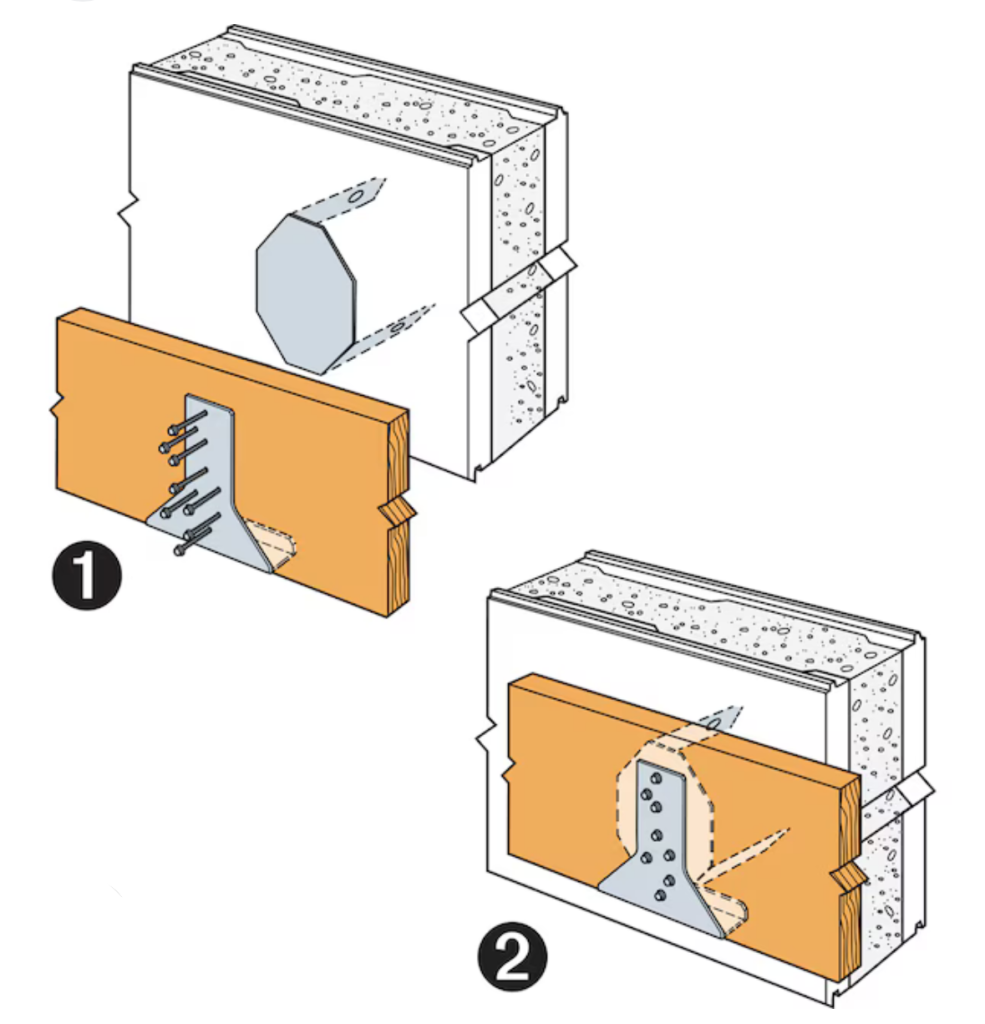
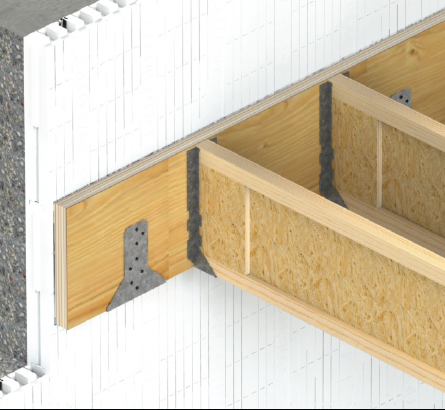
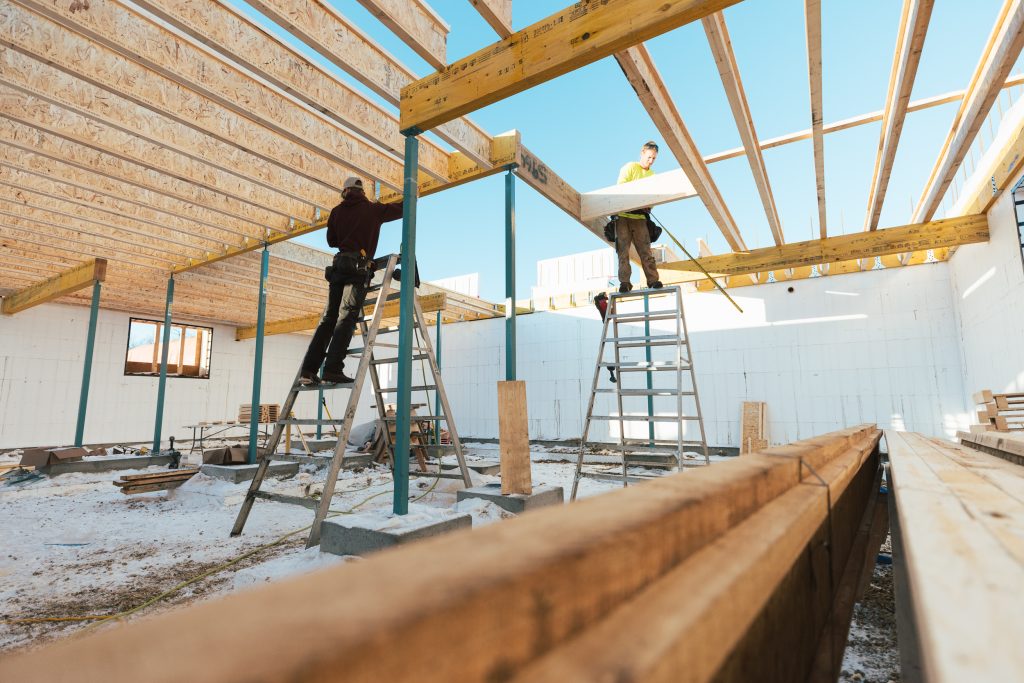
The floor system is connected to the ICF wall using a ledger board attached to the concrete wall with Simpson Strong-Tie connectors.
This approach is commonly used in ICF construction. The ledger board is fastened to the wall using structural connectors, and the floor system is then hung from that ledger board.
For builders familiar with ICF construction, this method is a typical and straightforward way to connect floor systems to the wall.
Simpson Strong-Tie System
Structural connectors anchor the framing directly into the ICF concrete core, creating a secure connection between assemblies while maintaining the wall’s performance.
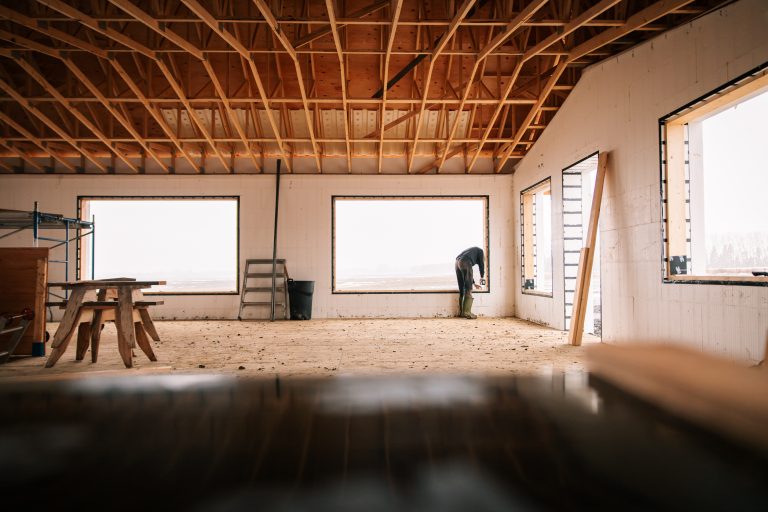
Dennis Borren and crew installing the floor system in their Passive House ICF build — where structure, airtightness, and careful sequencing all come together.
How is cladding attached to ICF walls, and is a rainscreen used?
The exterior wall assembly includes six inches of additional EPS insulation installed on the outside of the building.
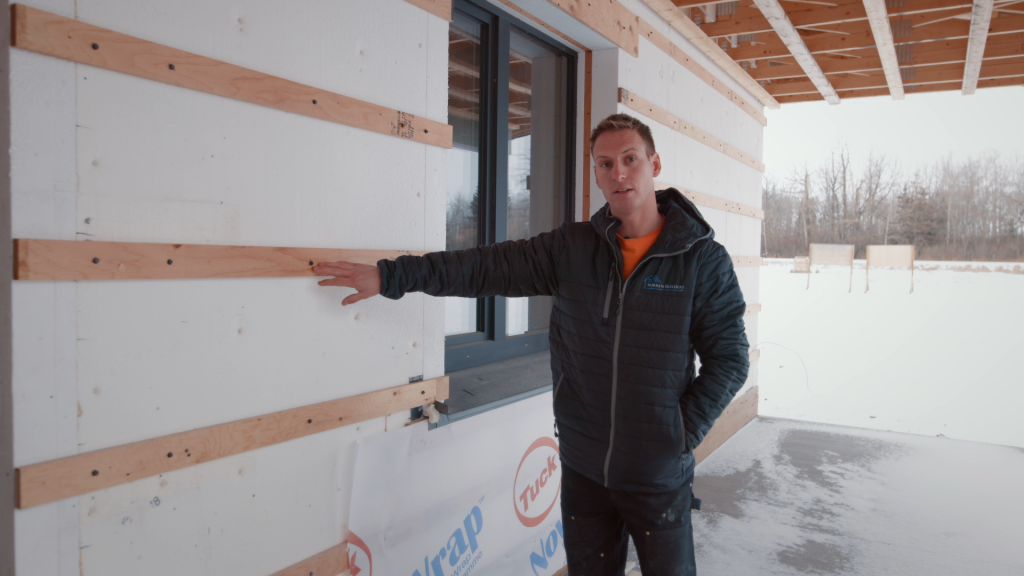
Over that insulation, the wall is first strapped using ¾-inch plywood, which is fastened with long TimberLok screws that extend back through the insulation and into the structure.
After this layer is installed, the house wrap is applied over the plywood sheathing.
The wall is then strapped again vertically using ¾-inch plywood strapping, creating a rainscreen cavity. This rainscreen space allows air movement and drainage behind the cladding.
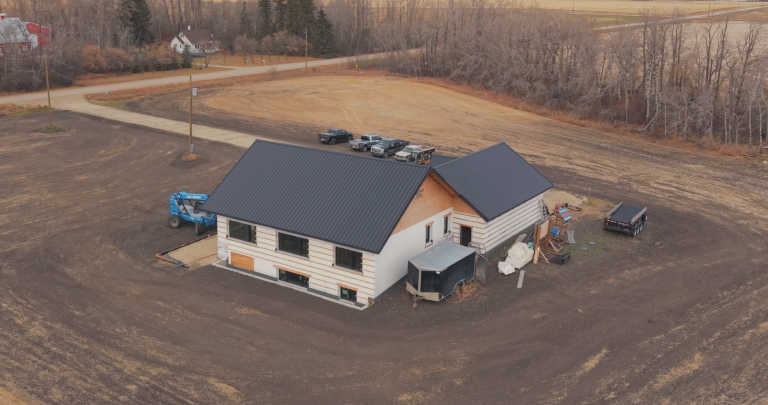
The rainscreen strapping also provides the attachment surface for the exterior siding. In this project, LP SmartSide siding will be installed, although the system allows for other conventional siding products to be used as well.
Dennis Borren discusses how cladding systems attach to ICF walls and why rainscreen assemblies are often used to help manage moisture and protect the building enclosure.
Don't miss a thing
Sign up to receive the latest info on new Element ICF products, special offers and more.
Wrapping Up
Passive House construction requires careful attention to every layer of the building enclosure.
In this project, the ICF concrete core provides the primary air barrier, while proper concrete consolidation, penetration detailing, and connections between assemblies help maintain that airtight layer.
Exterior insulation, rainscreen detailing, and standard structural connections complete the wall system while maintaining the performance required for high-performance construction.
As Dennis explains throughout this series, achieving Passive House performance comes down to planning the details early and executing them carefully on site.
About the High-Performance Builder
Dennis Borren Borren Builders | Central Alberta
Dennis specializes in high-performance ICF construction — building stronger, more energy-efficient homes and foundations across Central Alberta.
If you have questions about this article or are looking to collaborate, Dennis would be happy to engage with you:
Next, Dennis Borren walks us through one of the most detail-sensitive phases of any high-performance build — windows, doors, and structural connections. These are the moments where performance is often lost, where small gaps turn into long-term issues.
This series documents one builder’s experience using our products on a specific project. Construction methods vary, and the details shown here should not be interpreted as a universal recommendation or endorsement.
Whether you’re an experienced ICF installer or considering ICF for the first time, we can help. Simply complete this short form for a free quote (or to ask any question at all!).
Ask Anything is a virtual assistant, which utilizes artificial intelligence to answer questions relating to Element ICF (the “Services”). The Services were developed by Logix Brands Ltd. (“Logix”) in conjunction with existing Element ICF product information. You may provide input to the Services and receive output (the “Output”) from the Services based on your input. Due to the nature of the Services and artificial intelligence generally, the Output may not always be accurate. You should not rely on the Output from the Services as factual information or as a substitute for advice. If you require further information regarding the Output and/or Element ICF, please contact a Territory Manager or local Element ICF dealer. Logix, nor any of its affiliates or licensors will be liable for any direct, incidental, consequently or indirect damages (including lost profits) arising out of the use of the Services or adhering to the Output.
Building Soon?
We can help make your ICF dreams a reality! Please let us know how we can help or assist.
Please complete this form to this dealer a question or to request a quote on Element ICF products. If you would like a quote please upload your plan set (if available) and provide as much additional information as possible.
For unlimited access to all of our technical and marketing resources, please enter your information. We will also email you a copy of each of the items you select for quick future reference.