Passive House Meets ICF — Part 5: Roof & Ceiling Assembly
Print
Email
At A Glance
How Halo Interra creates a continuous roof air barrier
Insulation strategy combining rigid board and blown-in cellulose
How simple geometry supports airtight performance
Layered sealing strategies at roof-to-wall transitions
Performance doesn’t stop at the walls. It continues—right to the roof.
Because in high-performance construction, the roof assembly isn’t just about covering the structure. It’s about maintaining airtightness, controlling heat loss, and connecting every layer back to a continuous system.
In this phase of the build, Dennis Borren walks through how the roof assembly was detailed to maintain performance from wall to ceiling—without introducing weak points.
You can continue reading below, or watch the interview segment to hear Dennis walk through these details in his own words.
What material serves as the air control layer in the roof or ceiling assembly, and how is its continuity ensured throughout the assembly?
For this project, the air control layer at the roof connection is Halo Interra.
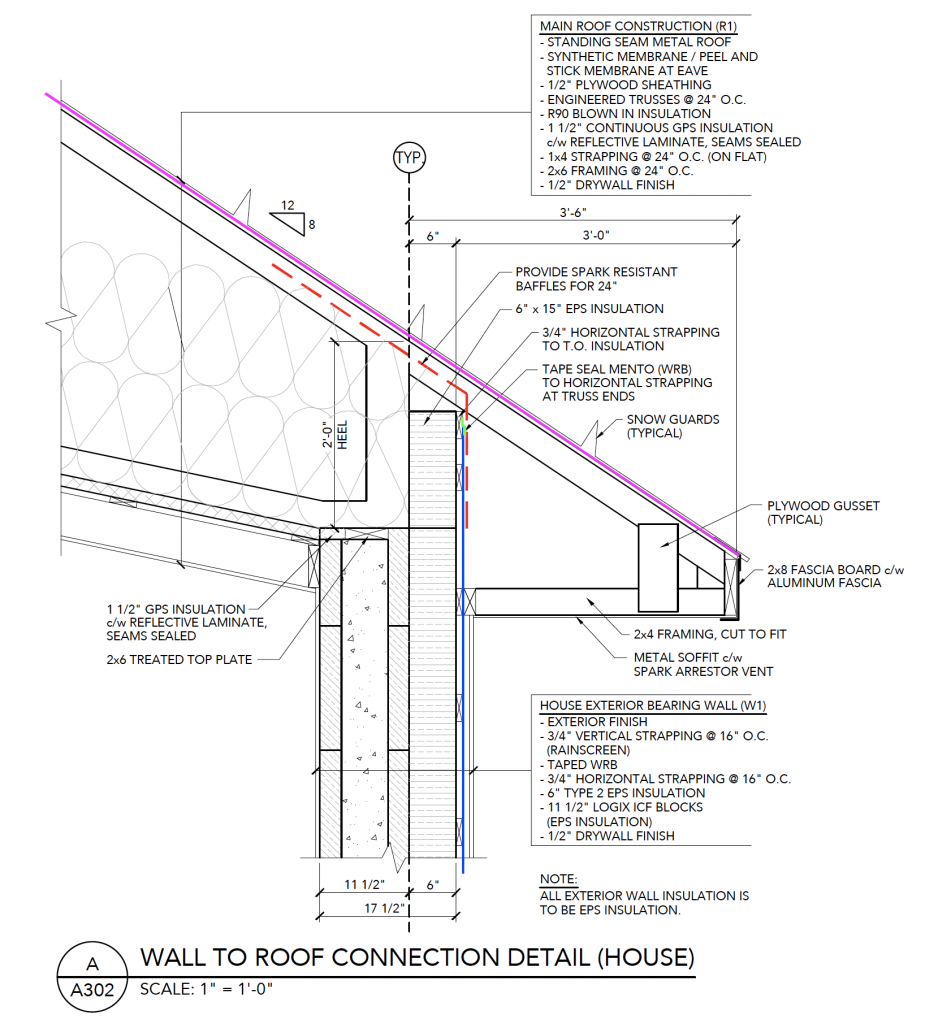
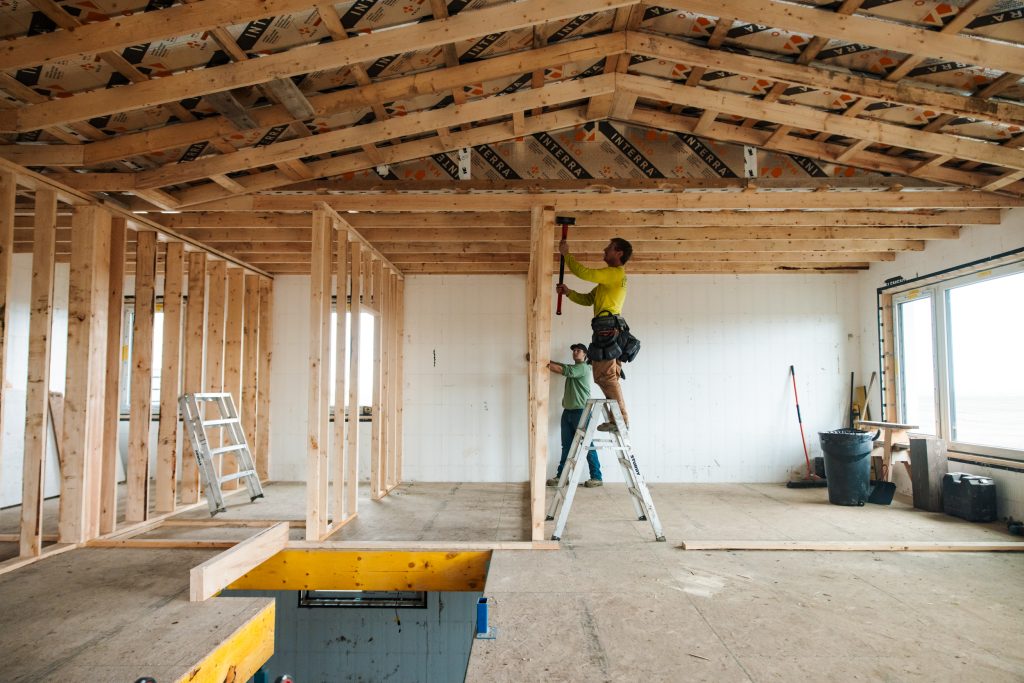
An inch and a half of Halo Interra was installed, with all joints taped to provide an airtight seal. That layer is then connected directly to the ICF concrete core.
At the top plate, poly (vapor barrier) is run underneath and sealed to the core using acoustic seal. That same poly is then taped to the Interra.
This creates a continuous connection from the wall system into the roof assembly—tying the air barrier together without interruption.
How is the roof or ceiling assembly insulated?
The assembly starts with 1.5 inches of Halo Interra, which provides both the initial insulation layer and the air barrier.
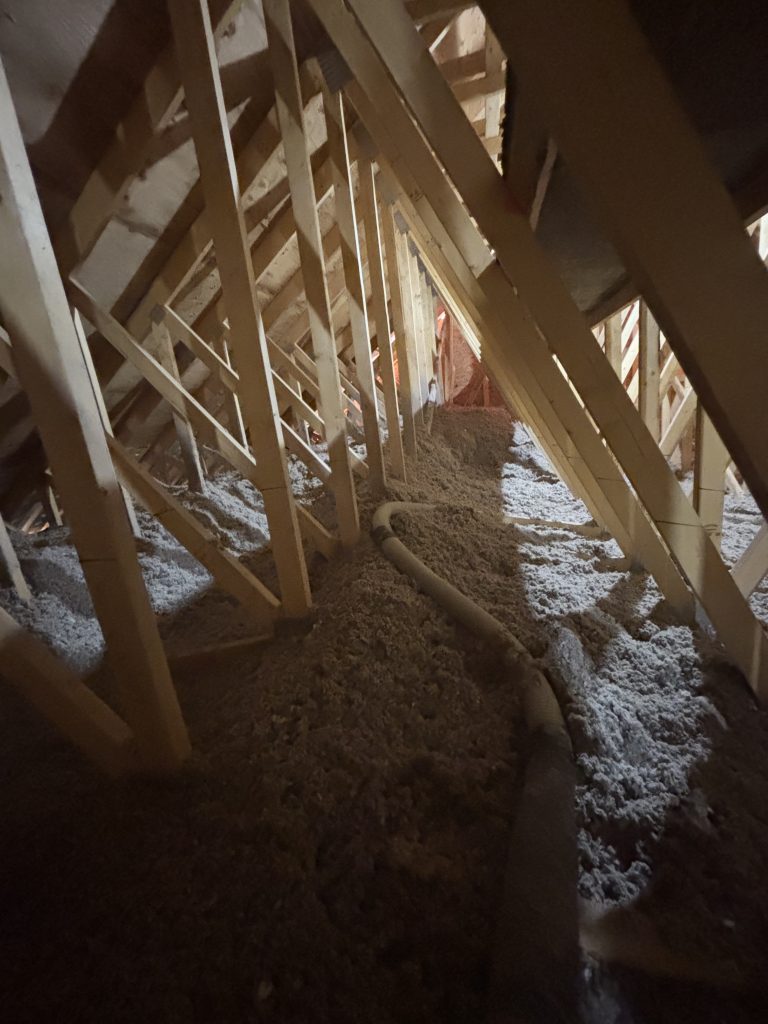
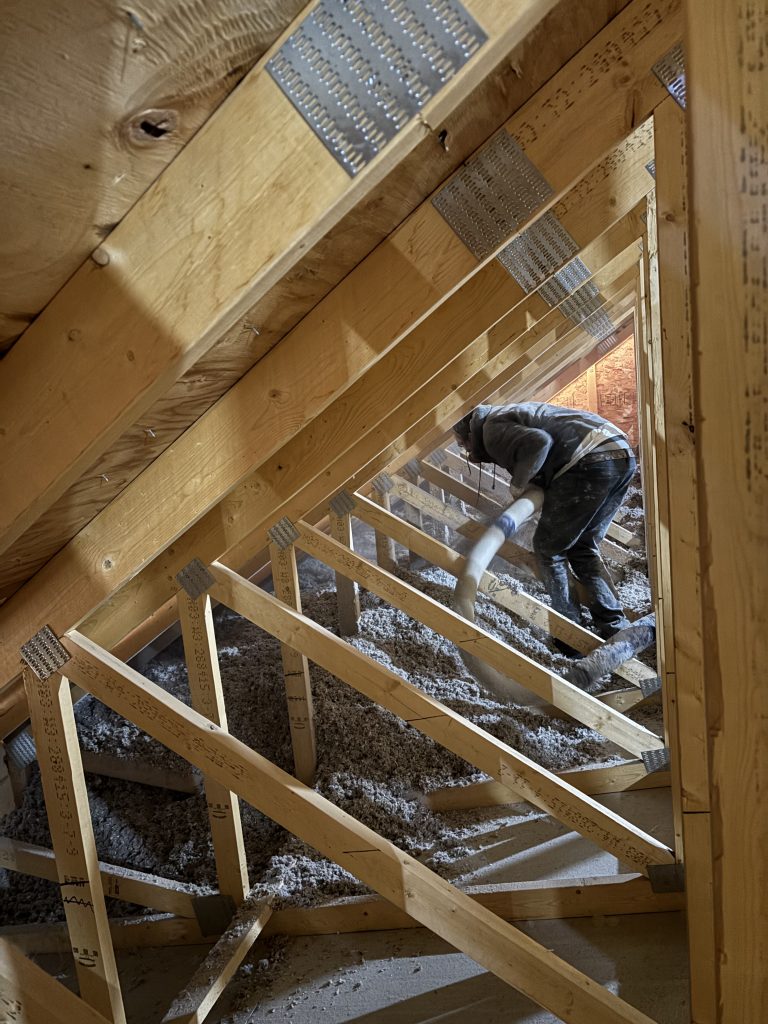
On top of that, R-90 cellulose is blown in.
The approach is similar to a standard install—but with significantly more insulation to meet performance targets.
What goes into the roof matters just as much as what goes on it.
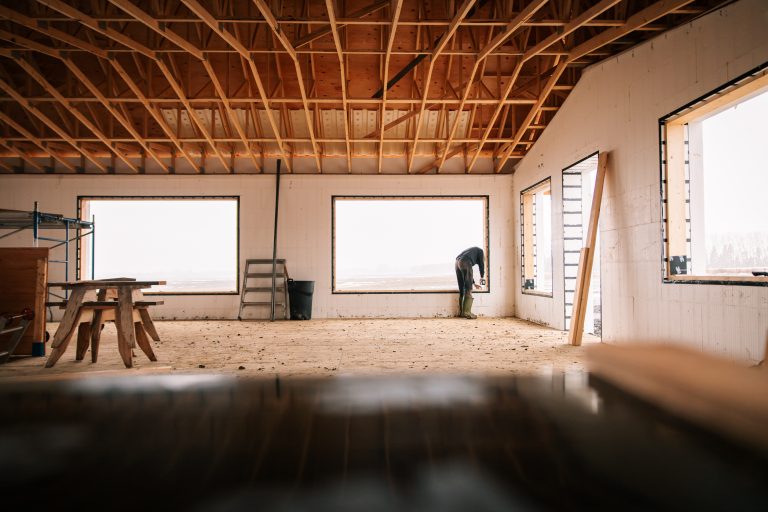
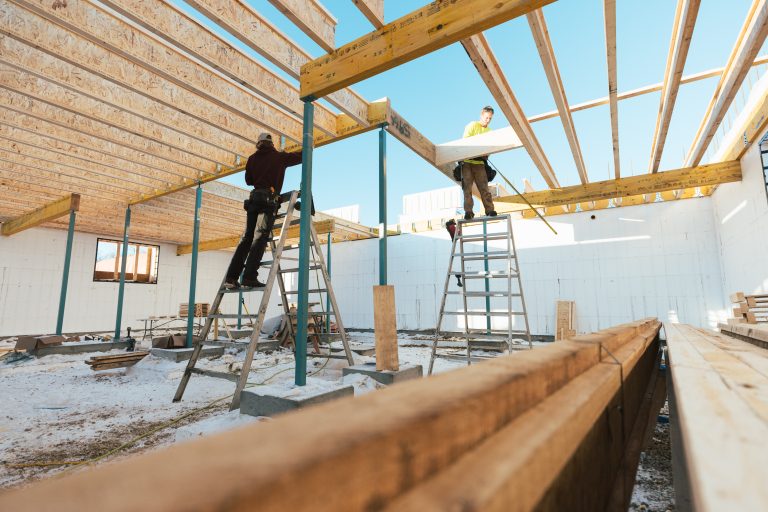
These ceiling cavities are now packed with blown-in insulation, helping create the thermal performance needed for a quieter, more energy-efficient home.
Combined with Halo Interra below, the assembly works as one continuous system designed to reduce heat loss and lock in comfort.
Were there challenges related to roof geometry and maintaining airtightness?
The geometry on this build was intentionally kept simple.
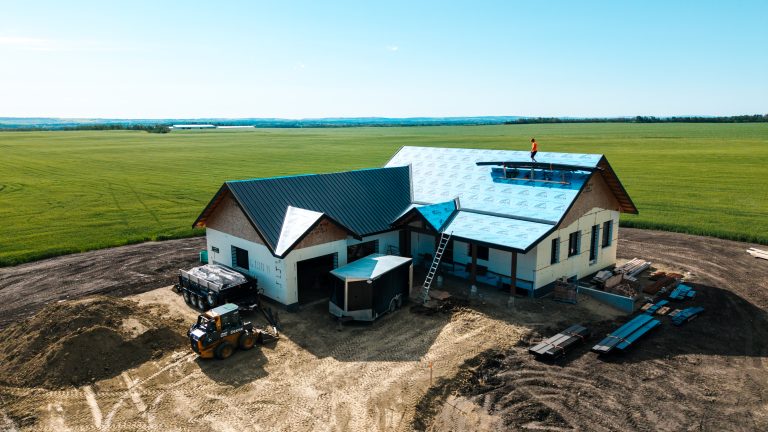
The house is designed with four corners to reduce exterior surface area while maintaining interior volume. This minimizes opportunities for heat loss and simplifies airtight detailing.
By avoiding complex geometry, the team reduced the number of transitions and potential failure points.
Did you use any specialty tapes, membranes, or gaskets at roof-to-wall transitions?
Yes—this transition includes multiple layers of sealing.
A top plate sits directly on the ICF concrete core, rather than spanning the full wall width. It matches the thickness of the Halo Interra (1.5 inches).
Once the trusses were installed, Halo Interra was run along the underside of the trusses and extended down to the top plate—fitting into the cavity between the truss and ICF wall.
From there, the Interra is taped to the interior foam of the ICF block, creating an additional sealed layer.
Before installing the top plate, a bead of acoustic seal was applied, along with 16-inch vapor barrier poly. This poly runs beneath the top plate and extends into the interior, where it is also taped to the Halo Interra.
The result is two layers of sealing protection at the wall-to-ceiling transition.
Dennis is keeping this build airtight and performance-ready with Halo Interra insulating the ceiling assembly—creating a continuous air barrier that connects roof to wall without compromise.
Why It Matters
The roof is where performance can break down—or come together.
On this project, it works because:
The air barrier connects cleanly from wall to ceiling
Insulation is layered and continuous
Geometry reduces complexity
Transitions are sealed with redundancy
Each detail supports the next.
Wrapping it Up
Airtightness isn’t one product.
It’s a system.
And when the roof ties back to the wall without gaps, breaks, or guesswork—you don’t just meet performance targets.
You build with confidence.
About the High-Performance Builder
Dennis Borren
Borren Builders | Central Alberta
Dennis specializes in high-performance ICF construction — building stronger, more energy-efficient homes and foundations across Central Alberta.
If you have questions about this article or are looking to collaborate, Dennis would be happy to engage with you:
Part 6: Finally, Dennis reflects on the real-world performance of the project — from early blower door test results to the unexpected site challenges that shaped the build. It’s a practical look at what it takes to execute Passive House standards with ICF, and what future builders can learn from the experience.
This series documents one builder’s experience using our products on a specific project. Construction methods vary, and the details shown here should not be interpreted as a universal recommendation or endorsement.
Whether you’re an experienced ICF installer or considering ICF for the first time, we can help. Simply complete this short form for a free quote (or to ask any question at all!).
Ask Anything is a virtual assistant, which utilizes artificial intelligence to answer questions relating to Element ICF (the “Services”). The Services were developed by Logix Brands Ltd. (“Logix”) in conjunction with existing Element ICF product information. You may provide input to the Services and receive output (the “Output”) from the Services based on your input. Due to the nature of the Services and artificial intelligence generally, the Output may not always be accurate. You should not rely on the Output from the Services as factual information or as a substitute for advice. If you require further information regarding the Output and/or Element ICF, please contact a Territory Manager or local Element ICF dealer. Logix, nor any of its affiliates or licensors will be liable for any direct, incidental, consequently or indirect damages (including lost profits) arising out of the use of the Services or adhering to the Output.
Building Soon?
We can help make your ICF dreams a reality! Please let us know how we can help or assist.
Please complete this form to this dealer a question or to request a quote on Element ICF products. If you would like a quote please upload your plan set (if available) and provide as much additional information as possible.
For unlimited access to all of our technical and marketing resources, please enter your information. We will also email you a copy of each of the items you select for quick future reference.