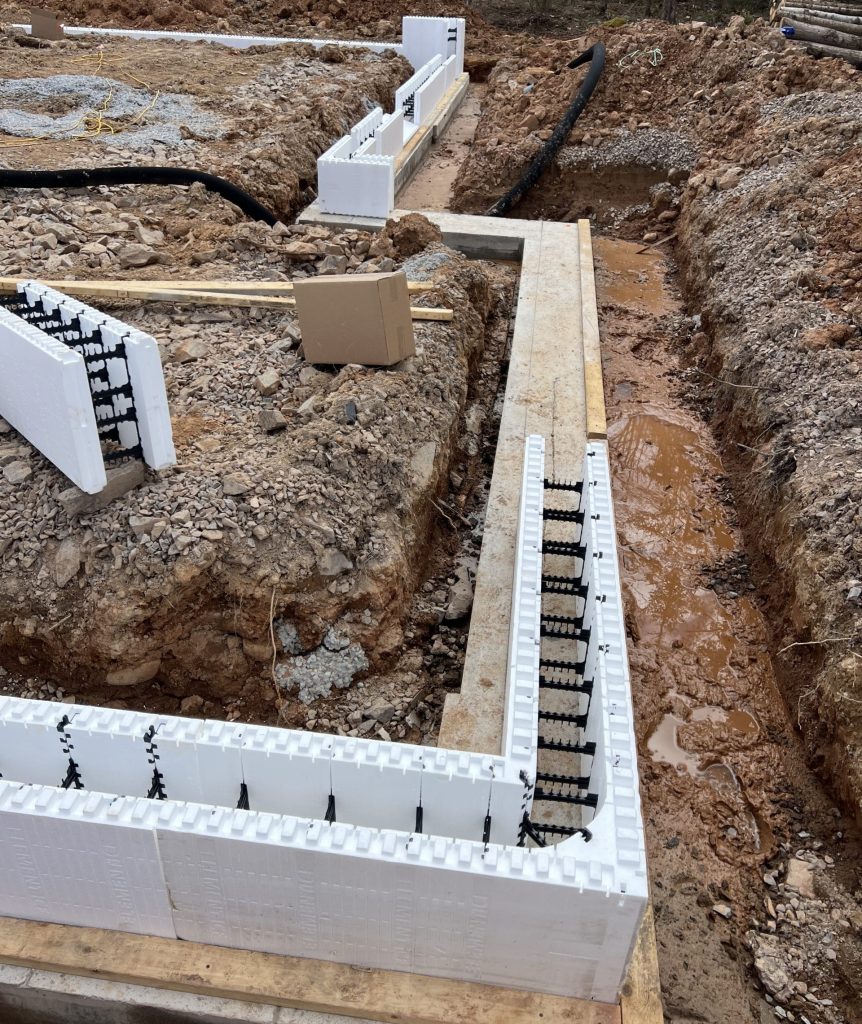
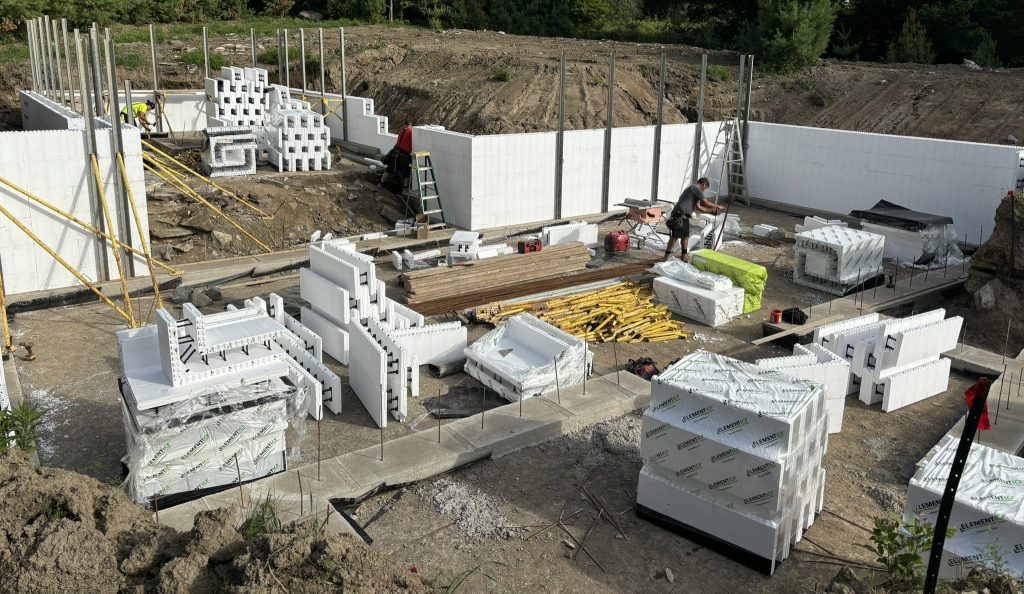
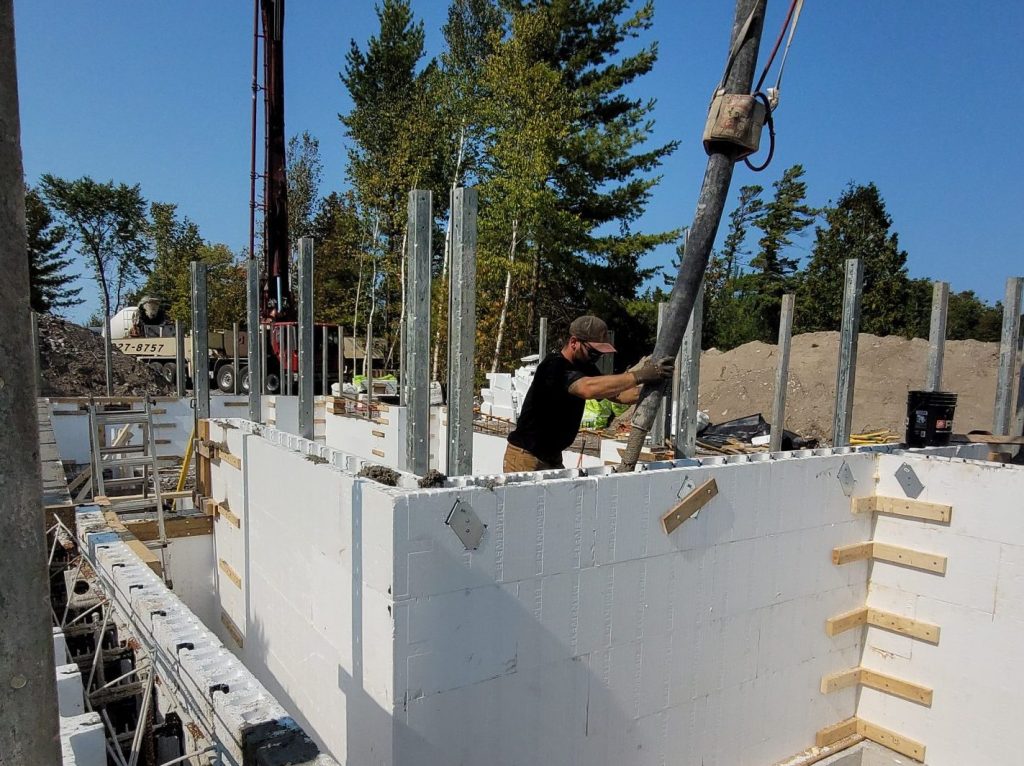
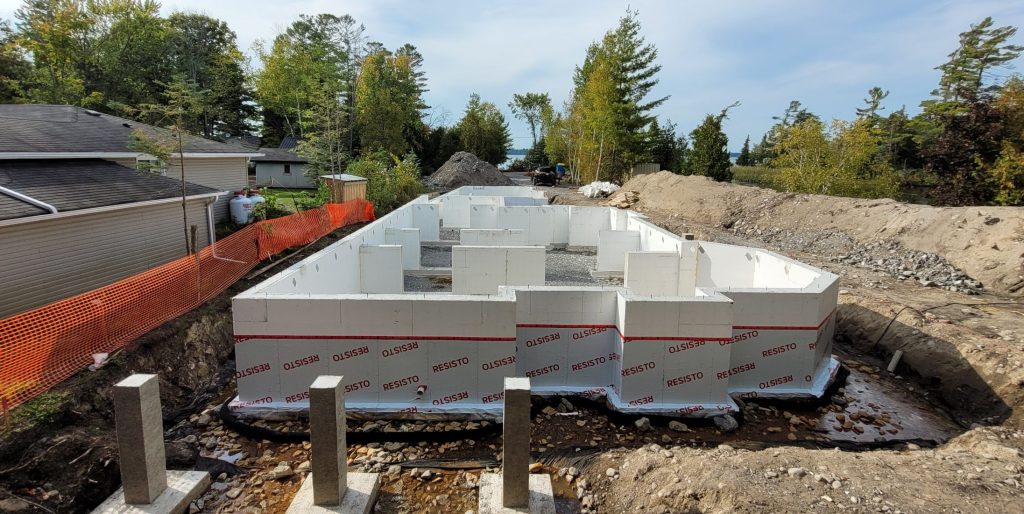
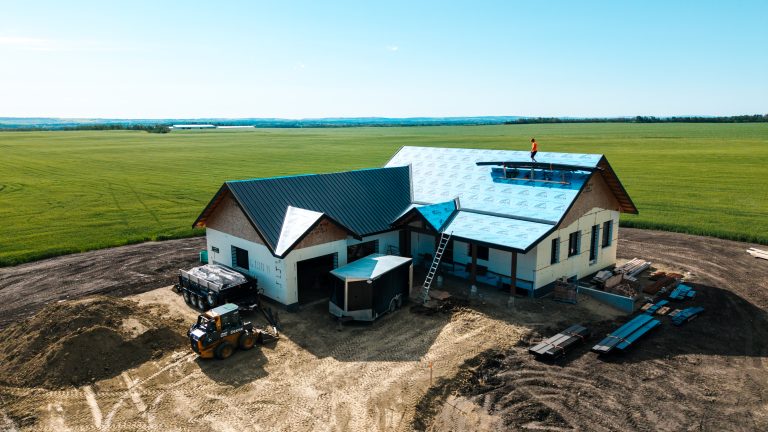
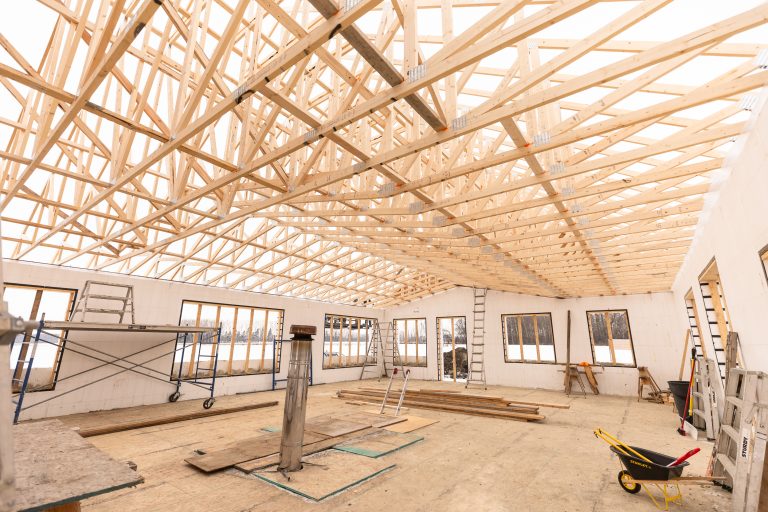
Proper prep and footing layout make the biggest difference in speed and accuracy — the first step toward a foundation that performs for life.
Bracing and careful handling are the secrets to straight, trouble-free walls — build it right, and it stays right.
Pouring in steady lifts with the right crew setup ensures strength and avoids issues — strength that lasts as long as the structure.
With Element ICF, a small experience crew can build a durable, energy-efficient foundation in just days — a lifetime of value from a week of work.
Building an ICF foundation doesn’t need to be intimidating. With Element ICF, you’ve got a system designed to be strong, flexible, and installer-friendly. The process follows a clear rhythm: prepare, stack, brace, pour, and finish.
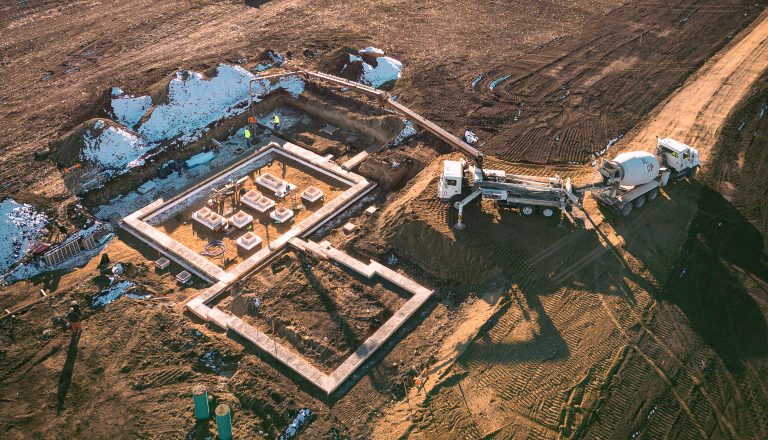
Below, we’ll walk through the key steps for a basic 40′ x 30′ foundation, assuming excavation and footings are complete, and materials are on site. With an experienced three-person crew, it’s possible to install the forms and build the foundation walls in about three days, pour concrete in one day, and strip bracing in one more day.
Every step you take here is more than construction — it’s the start of a Foundation For Life.
Step 1. Gather Your Tools
The basics are enough. Most contractors already own most of what’s needed: pruning saw or handsaw, 36″ zip ties, rebar bender, cordless drill, transit laser, string line, chalk line, low-expansion foam adhesive with applicator, and a pencil vibrator.
One specialty item you will need, though, is an ICF bracing system — you can rent these from a local Element ICF dealer and they are critical for straight, plumb walls.
Everything you need, nothing you don’t — simple tools for building lasting strength.
Step 2. Lay Out Your First Course
Corners first, then connect the dots.
Snap chalk lines to mark wall layout on footings.
Preserve layout with kicker plates (2×4 nailed to footing) or glue the first course with foam-safe adhesive.
You may choose to cut the interlock nodules off the bottom of the blocks for the first course for a flat bearing surface.
Start at corners, orient long legs all in one direction, and work around the foundation.
Plan vertical “stack seams” where walls join — preferably 4′ or more from corners or aligned with openings.
Mark modified forms with a bold X so crews know where extra strapping/bracing is needed.
Corners first, then connect the dots — accuracy here is the start of a lifetime foundation.
Step 3. Stack and Cut with Care
Smart stacking means faster progress.
Corners alternate direction on each successive course to create a 16″ overlap, locking strength into the wall system.
Place the standard, straight forms between corners, meeting in the middle.
Handle forms gently; cracks from rough handling often only show up during the pour.
Every block in place is another step toward strength that lasts for generations.
Step 4. Place Horizontal Rebar as You Go
Steel gives concrete its backbone.
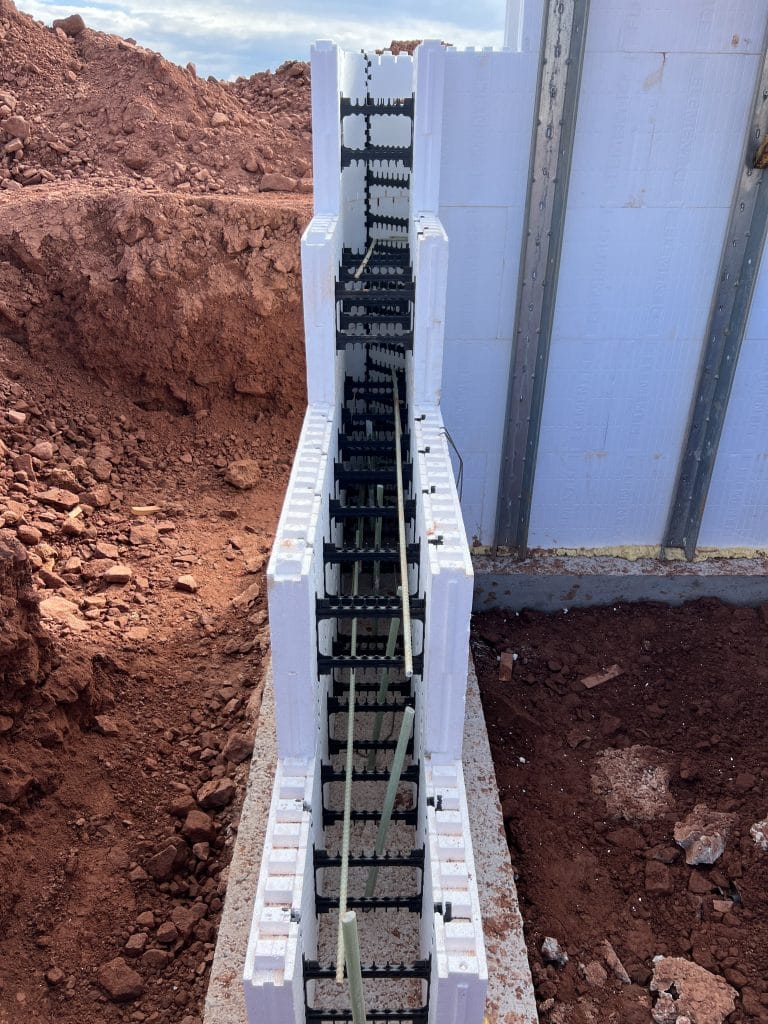
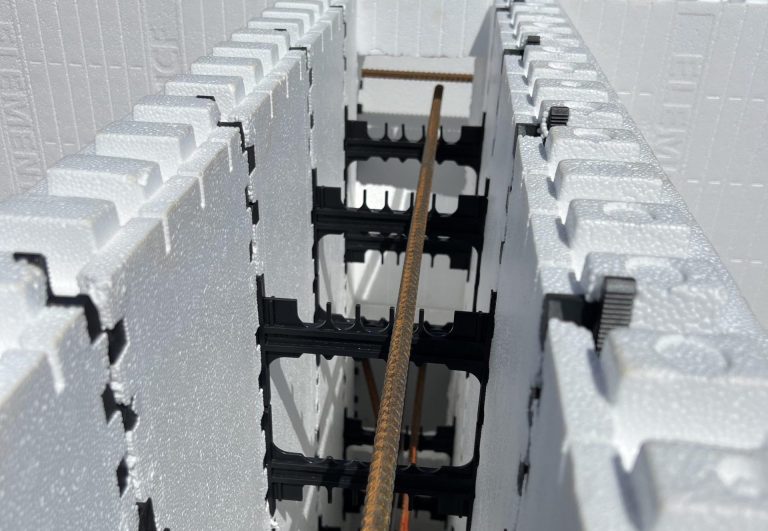
Place horizontal rebar in built-in chairs as you stack each course.
Follow stamped engineering drawings, prescriptive tables, or local code.
Maintain lap splice requirements (40× bar diameter) and proper clearances for concrete flow.
(Vertical rebar is threaded down through staggered courses of horizontal bar once the wall has been built to its full height.)
Steel inside, strength outside. Rebar locks performance into every wall.
Step 5. Install Bracing and Scaffolding
Straight, safe, and ready to pour.
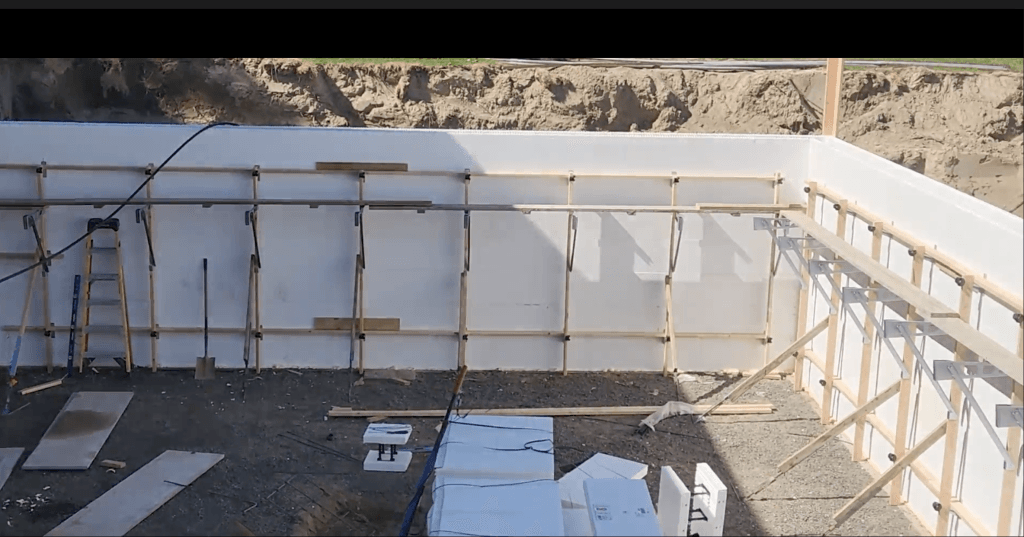
After 3–4 courses (around 5′), install ICF bracing at 6′ centers.
The bracing aligns the walls, provide scaffold access, and allow fine adjustments with turnbuckles.
Secure footplates firmly.
Use bracing consistently on both sides of marked seams, corners, and around openings.
Bracing isn’t just structural insurance — it’s your working platform for everything above eye level.
Bracing aligns, supports, and fine-tunes every wall — the setup that keeps your foundation true for life.
Learn More About Bracing Options
Build straight. Build safe. Choose the bracing system that fits your crew.
Zont Bracing — Compact and efficient. Ideal for smaller crews and tight sites.
Plumwall Bracing — Lightweight, quick setup, and adjustable for precision.
Giraffe Bracing — Heavy-duty strength built for long, tall, and tough pours.
Step 6. Pour and Consolidate Concrete
Slow and steady wins the pour.
Use a boom pump with reducer hose; target 5″–6″ slump.
Place in 4′ lifts, moving steadily around the foundation. Avoid dumping directly into corners.
Assign a crew of five: pump operator, spotter, two vibrators, and one roving “catch-all.”
Vibrate every 16″ cavity, especially near the webs, windows, and doors. Insert fast, withdraw slowly.
Plan three laps around: base fill, window/door fill, then topping to final height.
A steady pour today means walls that stand strong for a lifetime.
Step 7. Adjust, Strip, and Finish
Dial it in for the long haul.
As concrete sets, use turnbuckles to fine-tune walls to string lines.
Level and screed the top; place anchor bolts or embeds while concrete is workable.
After ~48 hours, strip bracing and prep for backfill or next-level framing.
Keep top joints covered with insulation blankets in cold weather to protect curing.
Finished, waterproofed, and true — ready for backfill or next-level framing. A Foundation For Life.
Wrapping Up
Building with Element ICF is about combining efficiency and strength. With just a few days of work, a small and experienced crew can complete a foundation that lasts for generations.
The process may feel new at first, but every course stacked builds confidence. Remember — solid prep, careful handling, consistent bracing, and steady pouring are the keys to success.
Whether you’re an experienced ICF installer or considering ICF for the first time, we can help. Simply complete this short form for a free quote (or to ask any question at all!).
Ask Anything is a virtual assistant, which utilizes artificial intelligence to answer questions relating to Element ICF (the “Services”). The Services were developed by Logix Brands Ltd. (“Logix”) in conjunction with existing Element ICF product information. You may provide input to the Services and receive output (the “Output”) from the Services based on your input. Due to the nature of the Services and artificial intelligence generally, the Output may not always be accurate. You should not rely on the Output from the Services as factual information or as a substitute for advice. If you require further information regarding the Output and/or Element ICF, please contact a Territory Manager or local Element ICF dealer. Logix, nor any of its affiliates or licensors will be liable for any direct, incidental, consequently or indirect damages (including lost profits) arising out of the use of the Services or adhering to the Output.
Building Soon?
We can help make your ICF dreams a reality! Please let us know how we can help or assist.
Please complete this form to this dealer a question or to request a quote on Element ICF products. If you would like a quote please upload your plan set (if available) and provide as much additional information as possible.
For unlimited access to all of our technical and marketing resources, please enter your information. We will also email you a copy of each of the items you select for quick future reference.